
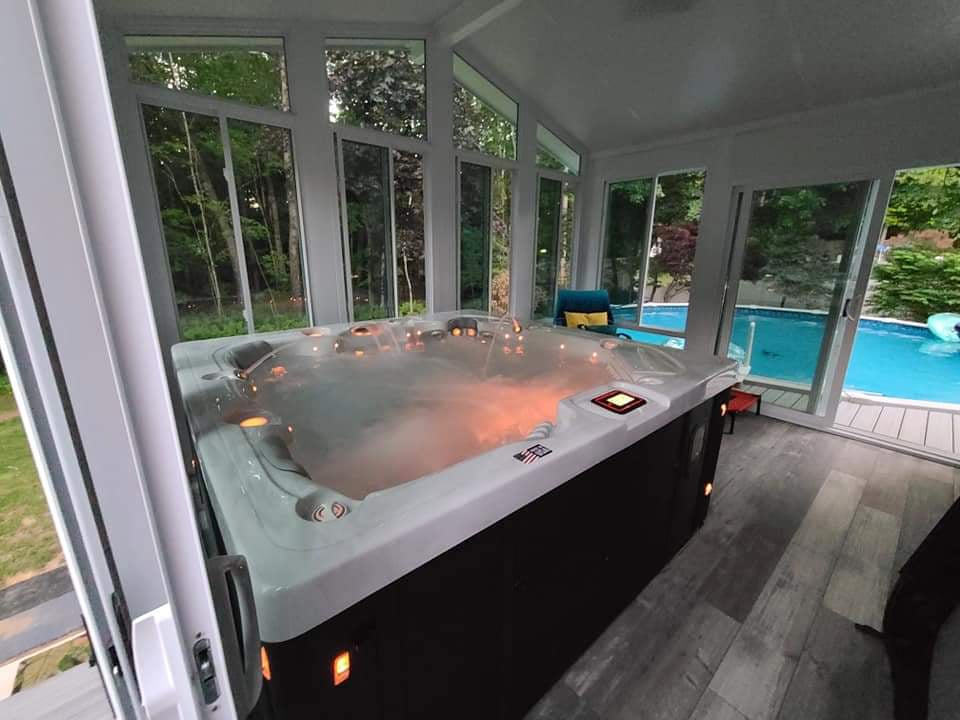
Can a Hot Tub Go in a Sunroom?
Yes, a hot tub can sometimes be installed in a sunroom—but only if the room is designed or professionally evaluated to handle it.
Before installing one, you need to address:
- Structural support for the filled hot tub
- Humidity and condensation
- Ventilation and moisture control
- Water-resistant flooring and drainage planning
- Electrical requirements
- Access for installation and future service
- The type of sunroom and how you plan to use it
Do not assume an existing sunroom, patio enclosure, or deck can safely support a hot tub just because there is enough floor space.
If a hot tub is part of your vision for a new sunroom, tell the designer before the room is engineered and built.
Why Put a Hot Tub in a Sunroom?
It is easy to understand the appeal.
A hot tub in an enclosed sunroom can give you:
- More privacy than an exposed deck or patio
- Protection from rain, snow, and wind
- Natural light and outdoor views
- Easier access from inside the home
- A dedicated relaxation space
- More opportunities to use the spa during changing weather
A sunroom can create the feeling of being outdoors without leaving the hot tub completely exposed.
But putting a large container of warm water inside an enclosed room creates design challenges that a normal sitting room does not have.
That is why the project needs to begin with structure and moisture management, not décor.
The First Question: Can the Floor Support the Hot Tub?
This is the most important question.
A hot tub becomes extremely heavy after you add:
- The spa itself
- Hundreds of gallons of water
- People using it
That weight is concentrated in a relatively small area.
A sunroom floor, existing deck, or patio should not be assumed to have enough structural capacity without evaluation.
Related Article: Sunroom Flooring Options
Before Installing a Hot Tub, Determine:
- The empty weight of the spa
- Its water capacity
- Maximum expected number of occupants
- The tub's footprint
- The construction beneath the proposed location
- Whether reinforcement or a different foundation is required
If the sunroom is being planned from scratch, tell your Joyce designer that a hot tub is part of the project before structural design begins.
If the sunroom already exists, have the structure evaluated before ordering or filling the spa.
Do not use a hot tub catalog weight alone to decide whether a floor is strong enough.
The completed installation needs to account for the actual building and proposed tub.
Can You Put a Hot Tub on an Existing Deck Inside a Sunroom?
Possibly, but an existing deck deserves especially careful evaluation.
Decks are built for particular loads and conditions. Adding sunroom walls and a roof already changes what the structure is being asked to support. Adding a filled hot tub concentrates even more weight in one area.
Depending on the existing structure, the project may require:
- Additional supports
- New footings
- Structural reinforcement
- A dedicated slab or foundation solution
- Reconstruction of part of the deck
The correct solution depends on the house, deck, hot tub, and applicable building requirements.
Challenge #2: Hot Tubs Create a Lot of Humidity
Warm spa water releases moisture into the surrounding air, especially when the hot tub is uncovered and in use.
Outdoors, that moisture disperses.
Inside a sunroom, it can accumulate.
Without adequate moisture management, you may notice:
- Condensation on windows
- Wet frames or sills
- Damp finishes
- Persistent high humidity
- Mold or mildew conditions
- Premature deterioration of materials
The current Joyce hot-tub guidance specifically identifies moisture and humidity as major concerns when putting a spa inside a sunroom.
Why Windows May Fog
The room can contain warm, moisture-heavy air while the glass is considerably cooler.
When that humid air reaches a sufficiently cool glass surface, condensation can form.
A little temporary window fogging is different from maintaining a room at persistently high humidity.
A hot-tub sunroom should be planned to manage the moisture rather than relying on wiping down windows after every use.
Related Article: Condensation on New Windows
Challenge #3: You Need a Real Ventilation Plan
Opening a window occasionally is not the same as designing the room for moisture control.
The ventilation solution should account for how often the spa will be used, the size of the room, the climate, and the amount of moisture being produced.
Planning may involve options such as:
- Operable windows
- Mechanical exhaust
- Air circulation
- Dehumidification
- HVAC planning where appropriate
- Keeping the hot tub covered when it is not in use
Which solution is appropriate should be determined for the specific project.
Why a Hot Tub Cover Still Matters Indoors
A fitted cover helps limit evaporation when the spa is not being used.
That means less moisture entering the room between uses.
Even in an enclosed sunroom, keeping the spa covered when appropriate can be an important part of moisture management.
Challenge #4: Choose Flooring for Water, Not Just Appearance
Water is going to get outside the tub.
People climb out wet.
Water drips from swimsuits.
The tub may need to be drained.
Small splashes may happen every time it is used.
So the floor should be selected with that reality in mind.
Think About:
- Water resistance
- Slip resistance
- Drainage
- Ease of cleaning
- What happens if a larger amount of water spills
- How the flooring interacts with the structural base underneath
A beautiful interior floor that performs well in a normal sunroom may not be the right material around an indoor hot tub.
Challenge #5: Plan Electrical Work Before the Tub Arrives
Hot tubs have electrical requirements that need to be addressed safely.
Do not assume an ordinary sunroom receptacle is enough.
The spa manufacturer's installation instructions, applicable electrical requirements, and the home itself all need to be reviewed by a qualified electrician.
Electrical planning may affect:
- Circuit capacity
- Equipment placement
- Shutoff location
- Wiring route
- Panel capacity
- Locations of outlets or switches
- Protection around wet areas
That work should be discussed before the hot tub is moved into the room.
Never improvise hot-tub electrical connections with extension cords or temporary wiring.
Related Article: Electricity in Your Sunroom
Challenge #6: How Will You Get the Hot Tub Into the Sunroom?
This is easy to overlook.
A hot tub can be much larger than a normal doorway.
Before the room or spa is ordered, ask:
How will the tub physically get into the space?
Consider:
- Door width
- Window openings
- Exterior access
- Wall construction
- Construction sequence
- Equipment needed to move the spa
If the hot tub is part of a new sunroom project, it may be easier to coordinate delivery before every wall component is complete.
For an existing room, access may limit which spa sizes are practical.
Challenge #7: Leave Room for Service and Maintenance
Do not design the room so tightly around the tub that no one can service it.
Hot tubs require routine maintenance and may eventually need access to:
- Pumps
- Heaters
- Filters
- Plumbing
- Electrical components
- Drain connections
- Cabinet panels
Ask the spa manufacturer how much service clearance is required around the specific model.
A sunroom should have enough usable floor space for people to safely enter and exit the spa and for future maintenance.
Is a Three-Season or Four-Season Sunroom Better for a Hot Tub?
The answer depends on the project.
Joyce currently offers both three-season and four-season sunrooms. Three-season rooms are primarily intended for spring, summer, and fall use, while four-season rooms use more insulated components for broader year-round comfort. Joyce's four-season systems include features such as SmartShield Glass and the ClimateMaster® roof system.
But simply choosing a four-season room does not automatically make it hot-tub-ready.
A hot tub adds separate requirements for:
- Structural loading
- Humidity
- Ventilation
- Water management
- Electrical service
Those need to be incorporated into the design.
Related Article: Three vs Four Season Sunroom
Consider a More Insulated Sunroom If:
You want to use the spa through colder weather.
You want better control over the room's indoor environment.
You plan to integrate heating, cooling, or humidity management.
A Three-Season Room May Make Sense If:
The spa will mainly be used during milder seasons.
You do not need the space to perform like a conditioned room in winter.
Your project has been specifically designed for the hot tub and seasonal conditions.
The decision should come from the desired use—not simply the room label.
Should You Put the Hot Tub in the Sunroom or Outside?
Both options have advantages.
| Hot Tub in a Sunroom | Outdoor Hot Tub |
|---|---|
| More weather protection | Maximum natural ventilation |
| More privacy | Moisture disperses outdoors |
| Easier indoor access | Often simpler humidity management |
| Natural light and views | Less concern about indoor condensation |
| Can create a dedicated spa room | May require less specialized room design |
| Needs structural/moisture planning | Still requires proper base and electrical work |
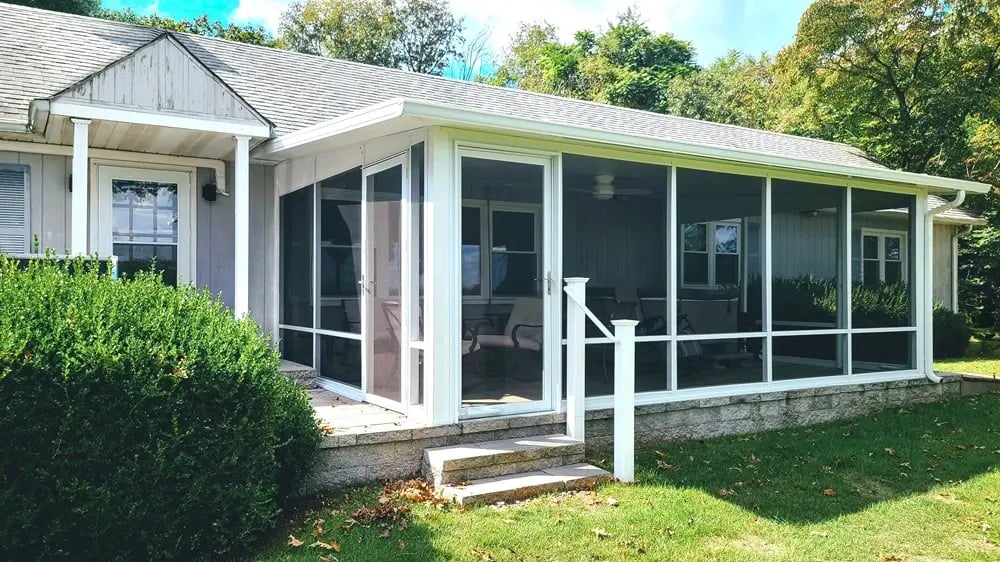
Should You Put a Hot Tub in a Screen Room?
A screen room offers more natural airflow than a fully glazed sunroom, which can help moisture disperse.
However, it also provides much less protection from temperature changes.
That may make it appealing for homeowners who want:
- Bug protection
- Open-air ventilation
- Some weather shelter
- A more outdoor hot-tub experience
But the same structural and electrical questions still apply.
A screen enclosure does not make an inadequate deck capable of supporting a spa.
What About a Patio Cover Over a Hot Tub?
For some homeowners, a patio cover may solve the main problem without enclosing the spa.
A patio cover can provide overhead shade and shelter while leaving the sides open.
That means:
- Better natural ventilation
- Less enclosed humidity
- Continued outdoor feel
- Protection from some overhead weather
If the primary goals are shade and weather protection rather than a fully enclosed spa room, this can be a simpler design direction to explore.
What Type of Sunroom Flooring Works Around a Hot Tub?
There is no single flooring material that is automatically right for every project.
The key requirements are practical.
Look for a floor system that is:
- Appropriate for repeated moisture exposure
- Easy to clean
- Slip resistant when appropriate
- Compatible with the underlying structure
- Suitable for the room's temperature conditions
Also plan what happens when the tub needs to be drained.
A hot tub may contain hundreds of gallons of water. That water needs a deliberate route out of the room.
Do not wait until the first water change to decide where it will go.
Do You Need a Floor Drain?
That depends on the project and local requirements.
A drain can be useful in a room built around substantial water use, but adding one involves plumbing, floor design, slope, waterproofing, and code considerations.
Discuss water management during design.
Even if the project does not include a floor drain, you need a safe plan for:
- Routine draining
- Splashing
- Accidental overflow
- Cleaning
Will a Hot Tub Damage Sunroom Windows?
Not necessarily, but uncontrolled moisture can create problems for the entire room.
The concern is not that hot-tub water somehow attacks a window simply by being nearby.
The concern is prolonged high humidity and condensation.
Good room design should try to prevent water from repeatedly collecting on:
- Glass
- Frames
- Trim
- Walls
- Ceiling components
A room designed for ordinary relaxing or dining may have different moisture conditions than a room containing a hot tub.
That distinction should be discussed during the design stage.
Can You Add a Hot Tub to an Existing Joyce Sunroom?
Possibly—but contact Joyce before doing it.
An existing sunroom was engineered and installed around its original project requirements.
Adding a hot tub changes how the space is used and may change:
- Floor loads
- Moisture levels
- Electrical requirements
- Ventilation needs
- Service access
Joyce or an appropriate qualified professional should evaluate whether the existing structure is suitable before the tub is installed.
Do not assume that because the room is a Joyce sunroom, it was automatically designed for a spa.
What Should You Tell Your Sunroom Designer?
If a hot tub is part of your plans, say so at the first consultation.
Provide as much information as possible about the proposed spa, including:
- Manufacturer
- Model
- Dimensions
- Empty weight
- Water capacity
- Maximum occupancy
- Electrical requirements
- Service-clearance requirements
The more specific the information, the easier it is to design around the actual spa instead of a theoretical one.

Questions to Ask Before Putting a Hot Tub in a Sunroom
Bring this checklist to the planning meeting.
Structure
Can the foundation and floor support the filled spa and occupants?
Does the structure need reinforcement?
Moisture
How will humidity be controlled?
What happens to condensation during cold weather?
Ventilation
Is mechanical exhaust or dehumidification needed?
Which windows can open?
Water
What flooring will be used?
How will spills be handled?
How will the tub be drained?
Electrical
What does this spa require?
Can the home's electrical system support it?
Who will perform the electrical work?
Access
How will the spa get into the room?
Is there enough clearance around it for repairs?
Room Type
Three-season or four-season?
How often will we use the tub in winter?
Answer those questions before worrying about paint colors or furniture.
How Much Does a Hot-Tub Sunroom Cost?
There is no single “hot-tub sunroom” price because the sunroom and hot tub are separate parts of the overall project.
Joyce currently lists year-round sunrooms at approximately $40,000 to $90,000, depending on size, materials, design, and installation requirements. Three-season rooms are generally listed around $35,000 to $70,000.
Those figures are sunroom planning ranges—not prices for the hot tub or specialized hot-tub work.
Adding a spa may introduce separate costs for:
- Structural upgrades
- Electrical work
- Ventilation
- Dehumidification
- Flooring
- Drainage
- Spa purchase and delivery
The only reliable way to budget the complete project is to design the room around the specific hot tub you are considering.
Frequently Asked Questions About Hot Tubs in Sunrooms
Can you put a hot tub inside a sunroom?
Yes, in some cases. The sunroom must be designed or evaluated for the hot tub's structural load, moisture, ventilation, electrical needs, flooring, drainage, and service access.
Can you put a hot tub on a sunroom floor?
Only if the floor and supporting structure are confirmed to be suitable for the filled spa and expected occupants. Do not assume an existing floor can carry the load.
Will a hot tub make sunroom windows condensate?
It can increase the likelihood of condensation because hot tubs release substantial moisture into the air. Adequate ventilation and humidity control are important in an enclosed room.
Is a four-season sunroom best for a hot tub?
A four-season room may offer better insulation for cold-weather use, but it is not automatically designed for a hot tub. Structural, moisture, ventilation, water, and electrical requirements still need to be addressed.
Do I need ventilation for an indoor hot tub?
Yes. Moisture management is a major consideration for any indoor hot-tub installation. The appropriate ventilation or dehumidification system depends on the room and spa.
Can I add a hot tub to my existing sunroom?
Possibly. Have the existing room professionally evaluated before installation because the spa changes the structural load, humidity, electrical requirements, and how the room is used.
Is a screen room better for a hot tub?
A screen room provides more natural ventilation but less temperature protection than an enclosed sunroom. Whether it is the better choice depends on your climate and how you want to use the spa.
Should I tell Joyce about the hot tub before building my sunroom?
Yes. If a hot tub is part of the plan, tell your Joyce designer before the room is engineered so its weight, dimensions, utilities, moisture, access, and service requirements can be considered.
The Best Time to Plan for a Hot Tub Is Before the Sunroom Is Built
A hot tub can turn the right sunroom into a private place to relax in almost any weather.
But it also changes what the room needs to do.
The floor has to support far more weight than ordinary furniture.
The room has to manage moisture.
Electrical work has to be planned safely.
Water needs somewhere to go.
And the spa still has to be accessible for future maintenance.
That is why the answer to “Can I put a hot tub in my sunroom?” is:
Yes—if the room is specifically designed or professionally confirmed to support one.
Joyce Windows, Sunrooms & Baths designs, manufactures, and installs custom three-season and four-season sunrooms, patio and deck enclosures, screen rooms, and patio covers. Joyce can help you compare room types and plan a new sunroom around how you want to use the space.
If a hot tub is part of that plan, bring the spa specifications to the conversation from the beginning.

