
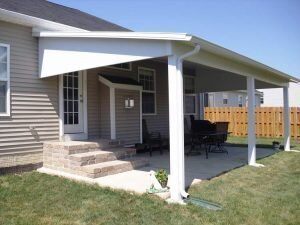
Summer weather does not always cooperate with your outdoor plans. Strong sun can make an uncovered patio uncomfortable, while a passing rain shower may send your family and guests indoors.
A patio cover adds a permanent roof over a patio, porch, or deck. It can provide shade, overhead weather protection, and a more comfortable setting for dining, relaxing, and entertaining—without fully enclosing the space.
Before choosing one, it helps to understand what a patio cover can and cannot do, how it compares with other outdoor-living options, and which project details affect the final cost.
Is a Patio Cover Worth It?
A patio cover may be worth considering when you want:
- Reliable shade over a patio, porch, or deck
- Overhead protection from sun and rain
- A more comfortable area for relaxing or entertaining
- A permanent structure custom-fitted to your home
- An open-air alternative to a screen room or sunroom
- Less direct exposure for outdoor furniture
A patio cover does not protect the sides of the space from insects, blowing rain, wind, heat, or cold. If you want a room that is enclosed on all sides, a screen room or three- or four-season sunroom may be a better fit.
Joyce Windows, Sunrooms & Baths designs and installs custom patio and porch covers using its insulated ClimateMaster® roof system. Each project is evaluated and designed for the home, existing outdoor area, and local conditions.
Ready to explore your options?

What Is a Patio Cover?
A patio cover is a permanent overhead structure installed above a patio, porch, or deck.
Unlike a fully enclosed sunroom, it normally leaves the sides open. This allows fresh air to move through the space while the roof provides shade and shelter from overhead weather.
A patio cover can create a defined outdoor area for:
- Meals
- Morning coffee
- Reading
- Grilling
- Family gatherings
- Outdoor furniture
- Children’s activities
- Pet-friendly shade
- Entertaining guests
Joyce patio covers are custom-designed to work with the home’s existing architecture and outdoor area. The company’s patio-cover system uses durable, low-maintenance materials and an insulated roof designed for weather protection and larger spans.
Related Article: Joyce Patio Covers
.jpg?width=500&height=375&name=Snyder%20Sunroom%20(5%20of%205).jpg)
How Can a Patio Cover Improve Your Summer?
1. It Provides Reliable Shade
An uncovered patio can become uncomfortable during the sunniest part of the day. A permanent roof creates consistent shade without requiring homeowners to open, close, or store an umbrella.
Shade may make the area more comfortable for:
- Eating outside
- Reading
- Working on a laptop
- Supervising children
- Relaxing with pets
- Hosting afternoon gatherings
The actual temperature under the cover will depend on the weather, roof design, air movement, orientation, and surrounding conditions. A patio cover creates shade, but it does not cool the area like an enclosed and conditioned room.
Outdoor-rated ceiling fans may help improve air movement when properly selected and installed by a qualified professional.
2. It Helps Protect Plans From Light Rain
A covered area gives you a place to move when a light shower arrives. You may be able to continue a meal, conversation, or quiet afternoon outside rather than immediately carrying everything indoors.
The level of protection depends on the cover’s size, roof pitch, drainage, wind direction, and the position of furniture. Because the sides remain open, wind-driven rain can still enter the space.
A patio cover should be presented as overhead protection—not as a fully weatherproof room.
3. It Creates a More Defined Outdoor Living Area
A roof helps an uncovered slab or deck feel like an intentional part of the home.
You can arrange the space around a specific purpose, such as:
- An outdoor dining area
- A shaded lounge
- A grilling and serving zone
- A covered play area
- A quiet reading retreat
- A gathering area beside a pool
- A transition between the home and backyard
Planning the purpose before selecting the cover’s size can prevent the finished space from feeling crowded.
4. It Reduces Direct Exposure for Outdoor Furnishings
A roof can help limit direct overhead sunlight and rainfall on outdoor tables, chairs, cushions, and decorations.
However, a patio cover does not eliminate weather exposure. Moisture, humidity, pollen, blowing rain, temperature changes, and low-angle sunlight can still reach furniture beneath it.
Choose furniture and fabrics rated for outdoor use, and follow the manufacturer’s cleaning and storage instructions.
5. It May Extend the Outdoor-Living Season
A covered patio can be useful beyond the hottest summer months. It may provide a place to enjoy spring rain, autumn leaves, or a quiet snowfall while remaining under a roof.
How often you can comfortably use the space depends on the local climate. An open-sided cover does not provide the insulation or temperature control of a four-season room.
What Does a Patio Cover Protect You From?
| Condition | What a patio cover can do | Important limitation |
|---|---|---|
| Direct overhead sun | Creates dependable shade | Low-angle sunlight may enter from the sides |
| Light rain | Provides overhead shelter | Wind-driven rain may reach the covered area |
| Snow | Keeps some snowfall off the patio beneath the roof | The structure must be properly engineered for applicable loads |
| Leaves and debris | Reduces material falling directly from above | Wind can still carry debris under the cover |
| Heat | Shade may improve comfort | The area remains outdoors and is not air-conditioned |
| Insects | Provides no meaningful barrier | Consider a screen room for insect protection |
| Wind | Offers little side protection | A partially or fully enclosed room provides more shelter |
| Cold weather | Provides a dry covered area | It does not create a heated, insulated living room |
Patio Cover vs. Pergola, Awning, Screen Room, and Sunroom
Different outdoor-living products solve different problems.
| Option | Roof or overhead protection | Side enclosure | Best for |
|---|---|---|---|
| Patio cover | Solid permanent roof | Open sides | Consistent shade and overhead rain protection |
| Pergola | Usually open or partially shaded top | Open sides | Architectural style and partial shade |
| Retractable awning | Fabric cover that extends and retracts | Open sides | Adjustable seasonal shade |
| Screen room | Solid roof with screened walls | Screened sides | Fresh air with insect protection |
| Three-season room | Roof, walls, windows, and screens | Enclosed | Broader spring-through-fall use |
| Four-season sunroom | Insulated roof and enclosed wall system | Enclosed | More consistent year-round use |
A patio cover may be the right choice when you want to preserve an open-air feeling. A screen room or sunroom may be better when insects, wind, humidity, or seasonal temperatures are your main concerns.
Joyce offers patio and porch covers, screen rooms, patio and deck enclosures, and custom three- and four-season sunrooms.
Related Article: Three-Season vs Four-Season Sunroom
Is a Patio Cover the Right Choice for Your Home?
A patio cover may be a strong fit when:
- Your patio becomes too sunny during the day.
- Light rain frequently interrupts outdoor plans.
- You want a permanent roof rather than a movable umbrella.
- You prefer an open-air space.
- You do not need protection from insects.
- You want the structure customized to your home.
- You plan to use the patio for dining or entertaining.
- You want a lower-complexity alternative to a fully enclosed room.
A patio cover may not be the best fit when:
- You need protection on all sides.
- Mosquitoes or other insects are your biggest frustration.
- You want an insulated living area.
- You need dependable comfort during very hot or cold weather.
- You prefer an unobstructed view of the sky.
- You want a retractable rather than permanent solution.
- Your existing patio or deck cannot support the proposed design without major structural work.
Can a Patio Cover Be Added to an Existing Patio or Deck?
In many cases, yes.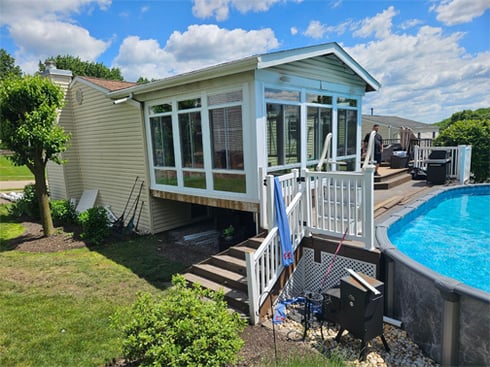
Before creating the final design, the existing area should be evaluated for:
- Structural support
- Condition of the patio or deck
- Drainage
- Attachment points
- Roof height and pitch
- Door and window placement
- Site access
- Local snow, wind, and weather requirements
- Permit and zoning requirements
- Electrical or lighting plans
A deck that was built for normal outdoor use may need additional support before a permanent roof can be added.
Joyce states that a representative evaluates existing patios and decks to check support, drainage, and how the proposed cover will integrate with the home.
Related Article: Converting a Deck Into Sunroom
What Patio Cover Features Should You Compare?
Roof Style
The roof should complement the home while providing the needed coverage and drainage.
Ask whether the design will be:
- Attached to the home
- Installed over a patio, porch, or deck
- Sloped away from the home
- Designed around existing windows and doors
- Coordinated with the home’s roofline
Roof Material and Insulation
Roof construction affects appearance, durability, shade, and heat transfer.
Joyce patio covers use the company’s insulated ClimateMaster® roof panel system. Joyce describes this system as designed to help reduce heat transfer while providing protection from sun, rain, and snow.
Exact panel specifications and performance should be confirmed for the proposed project.
Drainage
Ask how rainwater will move away from the roof, patio, foundation, and surrounding landscaping.
The design may need:
- Gutters
- Downspouts
- Proper roof pitch
- Drainage extensions
- Adjustments to the patio or surrounding grade
Size and Coverage
Measure more than the current furniture footprint. Consider walking paths, doors, grill placement, stairs, and where rain or low-angle sunlight may enter.
A cover that is too shallow may not protect the area you actually want to use.
Lighting and Fans
Electrical work may allow for:
- Ceiling fans
- Overhead lights
- Accent lighting
- Exterior outlets
Electrical features should be designed for outdoor conditions and installed according to applicable requirements.
Color and Architectural Fit
A patio cover should look connected to the home rather than added as an afterthought.
Compare:
- Roof shape
- Support-post placement
- Fascia details
- Color
- Scale
- Sight lines from indoors
- Relationship to doors and windows
How Much Does a Patio Cover Cost?
Patio-cover pricing varies from one home to another.
Important cost factors include:
- Overall dimensions
- Roof style
- Number and placement of support posts
- Existing patio or deck condition
- Structural reinforcement
- Roof-panel system
- Drainage features
- Site access
- Electrical work
- Permit requirements
- Removal of an old structure
- Local labor and installation conditions
- Custom colors or design details
A small, straightforward cover over a ground-level patio generally involves different work than a large roof over an elevated deck.
Joyce provides consultation-based patio-cover pricing because the existing structure and project design must be evaluated before an accurate quote can be prepared.
Related Article: Sunroom Costs Explained
Can a Patio Cover Handle Snow?
A permanent patio cover should be designed for the conditions that apply to the home, including relevant snow and wind loads.
Joyce's heavy-duty patio-cover roofs are designed to withstand ice and snow loads. The required design still depends on the property, location, roof span, attachment, engineering, and applicable building requirements.
Avoid promising that one standard roof configuration is suitable for every climate or every home.
Homeowners should ask:
- Which local weather loads were used in the design?
- Is project-specific engineering required?
- How will snow move or accumulate around the roof?
- What maintenance is recommended?
- What does the written warranty cover?
- Who should be contacted after severe weather?
Does a Patio Cover Add Home Value?
A well-designed patio cover may improve outdoor usability, appearance, and buyer appeal. However, no specific increase in resale value or return on investment can be guaranteed.
The result depends on: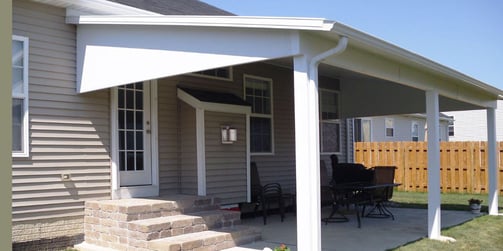
- Design quality
- Installation quality
- Condition of the home
- Local buyer preferences
- Real estate market conditions
- Permit status
- How well the cover matches the house
- The amount of usable space it creates
The most dependable value is the use and enjoyment the homeowner receives while living in the home.
What Makes Joyce Patio Covers Different?
Joyce Windows, Sunrooms & Baths provides custom patio covers as part of its outdoor-living and sunroom services.
Joyce patio covers feature:
- Custom designs fitted to the home
- An insulated ClimateMaster® roof-panel system
- Permanent shade and overhead weather protection
- Low-maintenance materials
- Designs intended for patios, decks, and porches
- Professional installation
- Consultation-based planning and pricing
Joyce designs, manufactures, and installs its own sunroom and enclosure systems, providing homeowners with one team from the design stage through installation.
Joyce has served homeowners since 1955 and currently provides sunrooms, patio enclosures, screen rooms, and patio covers in areas of Ohio, Pennsylvania, North Carolina, and South Carolina.

Frequently Asked Questions About Patio Covers
Will a patio cover work with my existing patio or deck?
In many cases, yes. The existing area must be evaluated for support, drainage, condition, attachment, and compatibility with the proposed design. Structural upgrades may be necessary.
Does a patio cover protect against rain?
It provides overhead protection and may keep the area beneath it usable during light rain. Because the sides remain open, wind-driven rain can still enter.
Will a patio cover make my patio cooler?
Shade can make an outdoor area feel more comfortable by reducing direct sun exposure. The result depends on the weather, roof orientation, airflow, and surrounding conditions. A patio cover does not air-condition the space.
Does a patio cover block UV rays?
A solid roof blocks direct sunlight from above and provides shade beneath the covered area. Indirect and low-angle sunlight can still reach the patio from the open sides.
Can I add lights or a ceiling fan?
Electrical features may be possible, depending on the design and local requirements. Use outdoor-rated products and qualified electrical installation.
Is a patio cover the same as a pergola?
No. A patio cover normally has a solid roof that provides consistent overhead shelter. A traditional pergola has an open or partially open top and generally provides less weather protection.
Is a patio cover the same as a sunroom?
No. A patio cover has an overhead roof with open sides. A sunroom includes walls, windows, or screens and provides more protection from insects and changing weather.
Can a patio cover be enclosed later?
Some projects may be designed with future enclosure in mind, but this should not be assumed. Tell your designer about future plans before the cover is engineered and installed.
Does a patio cover require a permit?
Requirements vary by location and project scope. A permanent attached roof may be subject to zoning, setback, structural, and permit rules. Confirm the requirements for the property before construction begins.
How long does patio-cover installation take?
The schedule depends on design, engineering, permits, material preparation, site conditions, weather, and installation complexity. Request a project-specific schedule after the property has been evaluated.
Make More of Your Summer With a Custom Patio Cover
A patio cover will not control the weather, but it can make an outdoor area more practical when the sun is strong or a light rain shower moves through.
The best cover is designed around the home, the existing structure, the direction of the sun, drainage needs, and the way your family expects to use the space.
Joyce Windows, Sunrooms & Baths can help you compare a patio cover with screen-room, patio-enclosure, and sunroom options so you can choose the right level of shade, shelter, and seasonal comfort.

