
Executive Summary
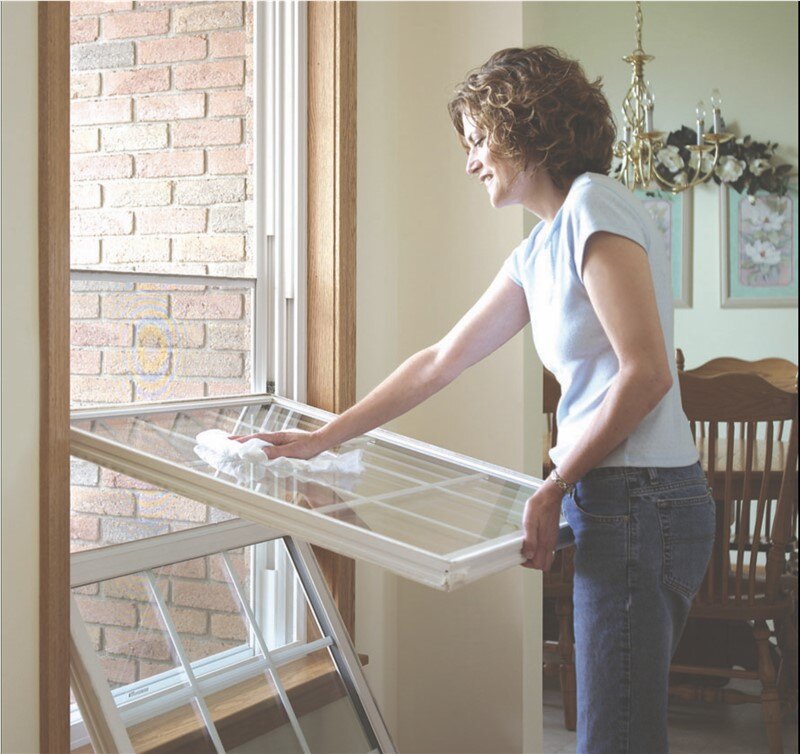
Many modern double-hung windows have tilt-in sashes that allow you to clean both sides of the glass from inside your home.
The basic process is:
- Remove curtains, blinds, and items from the sill.
- Unlock the window.
- Raise the lower sash slightly.
- Press both tilt latches at the same time.
- Support the sash as you tilt it inward.
- Lower the upper sash and tilt it inward.
- Clean the glass, frame, and tracks with mild products.
- Return the upper sash to the frame first.
- Return the lower sash and confirm both sides are secure.
- Close and lock the window.
Always keep both hands on a tilted sash. Do not force a latch, twist the sash, or allow its weight to hang from one side.
These instructions are intended for Joyce tilt-in double-hung windows. Window designs vary, so follow the care instructions for your specific product.
Why Are Double-Hung Windows Easier to Clean?
A double-hung window has two movable sections, called sashes. The lower sash moves upward, and the upper sash moves downward.
On Joyce double-hung windows, the sashes can tilt inward so the exterior glass can be reached from inside the home. This can make routine cleaning easier, particularly on upper floors, because homeowners do not need to lean outside or place a ladder beneath every window.
The tilt-in feature is also useful because it provides access to:
- Both sides of the glass
- Interior vinyl surfaces
- The window tracks
- The sill
- Areas where dust and insects may collect
The sash must still be handled carefully. It is part of the operating window system, not a loose panel intended to hang unsupported.
What You Need to Clean Double-Hung Windows
Gather your supplies before tilting the first sash.
Recommended supplies include:
- Two or three clean microfiber cloths
- A soft sponge
- A small soft-bristle brush
- A vacuum with a brush attachment
- A bucket of warm water
- A small amount of mild dish soap
- A nonabrasive glass cleaner approved for the window
- A dry towel for the sill
- A stable floor mat or drop cloth
Avoid using:
- Steel wool
- Scouring pads
- Razor blades
- Abrasive powders
- Harsh solvents
- Undiluted bleach
- Highly alkaline cleaners
- Sharp tools in the tracks
- Any product prohibited by the window warranty or care guide
Never mix household cleaning chemicals.
Before You Begin: Follow These Safety Steps
Tilt-in windows make cleaning more convenient, but the sashes can be heavy.
Before cleaning:
- Keep children and pets out of the work area.
- Remove fragile items from the sill.
- Move furniture that prevents you from standing directly in front of the window.
- Take down curtains or blinds that interfere with the sash.
- Make sure your hands and the floor are dry.
- Work on one window at a time.
- Support each sash with both hands.
- Stop if the sash feels unusually heavy, loose, jammed, or unstable.
Do not stand on a chair, windowsill, or unstable stool.
If the window does not tilt as expected, do not force it. Contact Joyce Customer Service when the window was installed by Joyce.
How to Clean a Joyce Double-Hung Window Step by Step
Step 1: Unlock the Window
Move the lock to the fully unlocked position.
If the window has more than one lock, release all of them before attempting to move either sash.
Trying to tilt a locked sash can damage the lock, meeting rail, or tilt mechanism.
Step 2: Raise the Lower Sash Slightly
Lift the lower sash several inches above the sill.
This creates enough space for the sash to tilt inward without striking the sill or interior trim.
Use the sash lift rail rather than pulling on the glass, lock, or top edge.
Step 3: Release Both Lower-Sash Tilt Latches
Locate the tilt latches near the top corners of the lower sash.
Slide or press both latches toward the center at the same time. The exact latch shape can vary by window collection.
Keep one hand positioned to support the sash while releasing the latches.
Both sides must disengage. Pulling inward when only one side is released may twist the sash or damage its hardware.
Step 4: Tilt the Lower Sash Inward
With both latches released, gently pull the top of the lower sash toward you.
Tilt it inward slowly until it reaches a comfortable cleaning position.
Continue supporting it. Do not drop it forward or let it hang from one corner.
Depending on the window, the sash may rest at an angle or nearly horizontal. Do not press it farther than the mechanism naturally allows.
Step 5: Lower the Upper Sash
With the lower sash supported, pull the upper sash down several inches.
Lower it enough to reach the upper-sash tilt latches comfortably.
Use the sash rail or designated handhold. Do not pull on the glass.
Step 6: Release and Tilt the Upper Sash
Press both upper-sash tilt latches toward the center.
Support the upper sash and carefully pull its top edge inward.
The upper sash should generally rest above the tilted lower sash. Keep the sashes from striking each other.
Clean and return the upper sash before returning the lower sash.
Step 7: Clean the Glass
Remove loose dust first with a dry microfiber cloth.
For routine cleaning:
- Dampen a soft cloth or sponge with warm water and a small amount of mild soap.
- Wipe the glass from top to bottom.
- Use a separate clean, damp cloth to remove soap residue.
- Dry the glass with a clean microfiber cloth.
A manufacturer-approved, nonabrasive glass cleaner may also be used.
Spray cleaner onto the cloth rather than heavily spraying the window. This helps prevent excess liquid from entering tracks, hardware, seals, and surrounding finishes.
For fewer streaks:
- Clean the window out of direct sunlight when possible.
- Use clean cloths.
- Replace dirty cleaning water.
- Dry the edges of the glass.
- Avoid using too much soap.
Step 8: Clean the Vinyl Frame and Sash
Use mild soap, warm water, and a soft cloth to clean vinyl surfaces.
Pay attention to:
- The sash rails
- Corners
- Lock area
- Lift rail
- Interior frame
- Sill
- Areas around the weatherstripping
Do not scrub weatherstripping aggressively or pull it out of position.
Avoid abrasive cleaners or tools that may scratch, dull, or discolor the vinyl.
Step 9: Clean the Tracks and Sill
Use a vacuum with a soft brush attachment to remove:
- Dust
- Dead insects
- Pet hair
- Loose dirt
- Small leaves
- Other dry debris
Use a soft brush for corners that are difficult to reach.
Wipe the tracks with a lightly damp cloth, then dry them. Do not flood the track with water.
Look for small drainage openings in the window frame. Keep them free of loose debris, but do not enlarge them or insert sharp objects.
Do not apply oil, household grease, or spray lubricant unless Joyce’s care instructions specifically approve it. The wrong lubricant may attract dirt or affect window components.
Step 10: Return the Upper Sash to the Frame
The upper sash should be returned first.
Support it with both hands and rotate it upward toward the frame.
Push gently until both tilt latches engage. You may hear or feel each side click into place.
Check both corners. The sash should sit evenly in the frame and should not pull inward when lightly tested.
Slide the upper sash completely upward.
Step 11: Return the Lower Sash
Support the lower sash and rotate it upward.
Guide both sides evenly into the frame until the tilt latches engage.
Check that:
- Both corners are secure
- The sash is level
- It slides smoothly
- It does not pull inward
- The weatherstripping remains correctly positioned
Do not operate or lock the window when one side of the sash is not fully engaged.
Step 12: Close and Lock the Window Properly
Raise the lower sash using its lift rail, then lower it fully into the closed position.
Confirm that the upper sash is pushed completely upward. Double-hung windows may not lock properly when either sash is slightly open.
Engage every lock and verify that it closes without excessive force.
Do not pull or push the lower sash by its top edge. Use the lift rail to reduce stress on the sash and hardware.
Double-Hung Window Cleaning Checklist
| Area | Cleaning Method | Avoid |
|---|---|---|
| Glass | Mild soap and water or approved glass cleaner | Abrasives, razor blades, harsh chemicals |
| Vinyl frame | Soft cloth with mild soap and water | Scouring pads, solvents, abrasive powder |
| Tracks | Vacuum, soft brush, lightly damp cloth | Flooding with water or scraping with metal tools |
| Sill | Mild soap, damp cloth, then dry | Allowing standing water to remain |
| Locks and hardware | Dry or lightly damp cloth | Unapproved oils and spray lubricants |
| Weatherstripping | Light dusting or gentle wiping | Pulling, scrubbing, or soaking |
| Screens | Follow the product-specific removal and cleaning instructions | Bending the frame or using high pressure |
How Often Should You Clean Double-Hung Windows?
The best schedule depends on the home and its surroundings.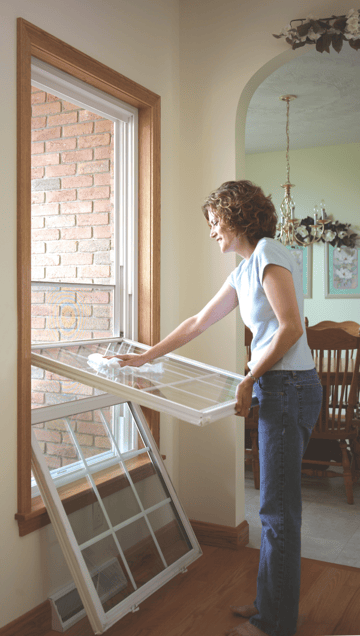
Many homeowners clean the glass seasonally or when buildup becomes visible. Tracks and sills may require more frequent attention in homes with:
- Pets
- Heavy pollen
- Nearby construction
- Dusty roads
- Frequent open-window use
- Insects
- Trees close to the house
- High indoor humidity
A practical schedule is:
- Monthly: Wipe visible dust from sills and inspect tracks.
- Seasonally: Clean the glass, frames, and tracks.
- After storms: Check for debris and water around the sill.
- As needed: Clean pollen, fingerprints, insects, and spots before they harden.
Regular light cleaning is usually easier than removing months of buildup.
How Do You Clean Double-Hung Window Screens?
Screen designs vary, so confirm how the screen is removed before applying pressure to it.
When the screen is designed to be removed:
- Place a towel on a flat surface.
- Remove the screen according to the window instructions.
- Vacuum loose dust with a soft brush attachment.
- Wash gently with mild soap and water.
- Rinse using low water pressure.
- Allow the screen to dry completely.
- Reinstall it evenly without forcing the frame.
Do not use a pressure washer. High pressure can stretch the mesh, bend the frame, or damage attachment points.
Do not lean a flexible screen against a wall while scrubbing it.
Common Problems While Cleaning Tilt-In Windows
| Problem | Possible Cause | What to Do |
|---|---|---|
| The sash will not tilt | Window is locked, sash is in the wrong position, or one latch is not released | Unlock it, reposition it, and release both latches evenly |
| One side tilts but the other does not | Only one tilt latch released | Return the sash to the frame and release both sides together |
| The sash feels loose | A pivot or balance component may not be correctly engaged | Support the sash and stop using the window |
| The sash will not stay up | Balance system may need service | Do not prop it with an object; request service |
| The window will not lock | One sash is not fully closed or seated | Push the upper sash fully up and lower sash fully down |
| The sash binds | It may not be square in the frame or both sides may not be engaged | Return it evenly and test again without forcing it |
| Water remains in the track | Drainage openings may contain debris | Remove loose debris gently and dry the sill |
| Glass remains streaky | Too much cleaner, dirty cloths, or cleaning in direct sun | Use less solution and clean with fresh microfiber cloths |
What Should You Never Do to a Double-Hung Window?
Avoid these common mistakes:
Do not force a stuck sash
Forcing the window can damage locks, latches, balances, or frame components.
Do not release only one tilt latch
Both sides should disengage together. Pulling one corner inward may twist the sash.
Do not let the sash hang from one side
The sash should remain evenly supported.
Do not remove hardware without instructions
The balance system and pivot components help support and operate the sash.
Do not use sharp scrapers on the glass or frame
Sharp tools can scratch glass, cut weatherstripping, and damage vinyl.
Do not flood the sill or tracks
Excess water can enter hardware areas or surrounding finishes.
Do not use a pressure washer
High-pressure water may damage seals, screens, caulk, finishes, or the surrounding wall.
Do not climb outside to clean tilt-in glass
The purpose of the tilt-in design is to provide interior access. Stop and request help if you cannot safely reach or operate the sash.
When Should You Call Joyce Customer Service?
Contact Joyce when a Joyce-installed window:
- Will not open or close
- Will not lock
- Drops instead of remaining open
- Has a loose or disconnected sash
- Has broken tilt latches
- Shows damaged weatherstripping
- Has glass fogging between the panes
- Allows water to enter
- Makes unusual scraping or grinding sounds
- Cannot be returned securely after tilting
Do not attempt to repair balances, insulated glass, locks, or structural frame components unless Joyce has provided specific instructions.
Joyce provides a customer-service channel for homeowners who need help with products installed by the company.
Why Homeowners Choose Double-Hung Windows
Easy cleaning is only one reason double-hung windows remain popular.
Because both sashes operate, homeowners can open the lower sash, upper sash, or both. This supports flexible ventilation without requiring the window to swing outward.
Double-hung windows may be useful in:
- Bedrooms
- Living rooms
- Dining rooms
- Home offices
- Kitchens
- Bathrooms
- Upper stories
- Areas near patios or walkways
Their vertical operation also saves exterior space compared with a window that swings outward.
Joyce offers custom-made double-hung replacement windows as part of its Heritage and Eloquence window collections. Current product options vary by collection, location, glass package, colors, grids, and project requirements.

When Is It Time to Replace a Double-Hung Window?
Cleaning cannot correct every window problem.
Replacement may be worth considering when the window has:
- Persistent drafts
- Rot or significant frame damage
- Fogging between insulated glass panes
- Broken seals
- Sashes that will not remain open
- Repeated water intrusion
- Locks that no longer secure properly
- Severe warping
- Difficult operation that service cannot correct
- Poor comfort compared with the rest of the home
New windows should not be recommended merely because an older window is dirty. First determine whether cleaning, maintenance, or repair is appropriate.
Joyce services windows it installed but does not provide general glass or window repair for products installed by other companies.
Why Choose Joyce Double-Hung Replacement Windows?
Joyce Windows, Sunrooms & Baths manufactures custom replacement windows through its factory-direct process.
Joyce double-hung windows are designed with:
- Two operable sashes
- Tilt-in access for interior cleaning
- Multiple ventilation options
- Custom sizing
- Available insulated-glass packages
- Low-maintenance frame materials
- Professional installation
- Multiple style and color options
Joyce offers Heritage and Eloquence window collections along with specialty window styles. A design consultant can help homeowners compare performance, design, glass, and budget options.
Joyce currently serves supported communities in Ohio, Pennsylvania, North Carolina, and South Carolina.
See What Replacement Windows Could Cost
Use the Joyce Window Pricing Calculator for a ballpark project estimate based on your selections.
Meet with a Joyce window specialist to compare double-hung windows, glass packages, colors, grids, installation needs, and exact project pricing.

Frequently Asked Questions
Can double-hung windows be cleaned from inside?
Many modern double-hung windows have tilt-in sashes that allow both sides of the glass to be cleaned from inside. Confirm that your specific window is designed to tilt before pulling the sash inward.
Which sash should I clean first?
Tilt the lower sash inward first, followed by the upper sash. When returning them to the frame, secure the upper sash first and then the lower sash.
Why won’t my double-hung window tilt inward?
The window may still be locked, the sash may be positioned incorrectly, or only one tilt latch may be released. Do not force it. Check the lock and both tilt latches.
Can I use glass cleaner on double-hung windows?
Use a nonabrasive glass cleaner approved for your window or mild soap and water. Spray the cloth instead of heavily spraying tracks, seals, or hardware.
Can I use vinegar on vinyl window frames?
Product-care guidance varies. Mild soap and water is the simplest general option. Use vinegar only when it is permitted by the manufacturer’s current care instructions and properly diluted.
Can I use a magic eraser on vinyl windows?
Avoid using abrasive cleaning pads unless the manufacturer specifically approves them. They may alter the sheen or appearance of vinyl surfaces.
Should I lubricate the window tracks?
Do not apply oil, grease, or spray lubricant unless Joyce recommends a specific product and application method. Some lubricants attract dirt or may affect window components.
Why won’t my window lock after cleaning?
The upper sash may not be pushed completely upward, the lower sash may not be fully closed, or one side may not be seated correctly after tilting. Recheck both sashes without forcing the lock.
What should I do if the sash comes loose?
Support it immediately and stop operating the window. Do not attempt to reconnect balance or pivot hardware without product-specific instructions. Contact Joyce when it is a Joyce-installed window.
How often should double-hung windows be cleaned?
Clean them when dirt, pollen, fingerprints, or debris become visible. Many homeowners perform a full cleaning seasonally and wipe sills and tracks more frequently.
Does Joyce repair all types of windows?
Joyce provides service for windows it installed. It does not offer general window or glass repair for products installed by other companies.
Final Takeaway
Tilt-in double-hung windows are designed to make routine cleaning safer and more convenient.
For the best results:
- Unlock the window before moving the sashes.
- Release both tilt latches together.
- Support each sash with both hands.
- Clean with mild, nonabrasive products.
- Vacuum debris before wiping the tracks.
- Return the upper sash first.
- Confirm that both sides are securely seated.
- Close and lock the window after cleaning.
- Stop and request service when the sash feels loose, damaged, or unstable.
A few careful steps can help protect the glass, vinyl, weatherstripping, and operating hardware while giving you a clearer view.
Looking for replacement windows that are easier to clean and operate? Explore Joyce double-hung windows, get a ballpark cost estimate, or book a design consultation.

Topics:





_flipped.jpg?width=3246&height=2550&name=joyce_%23034-outside(c)_flipped.jpg)